
IR35
IR35 Calculator: Inside vs Outside (2026/27).
Compare your net take-home as a limited-company contractor inside IR35 versus outside IR35 for 2026/27, including salary plus dividends versus deemed-employment PAYE.
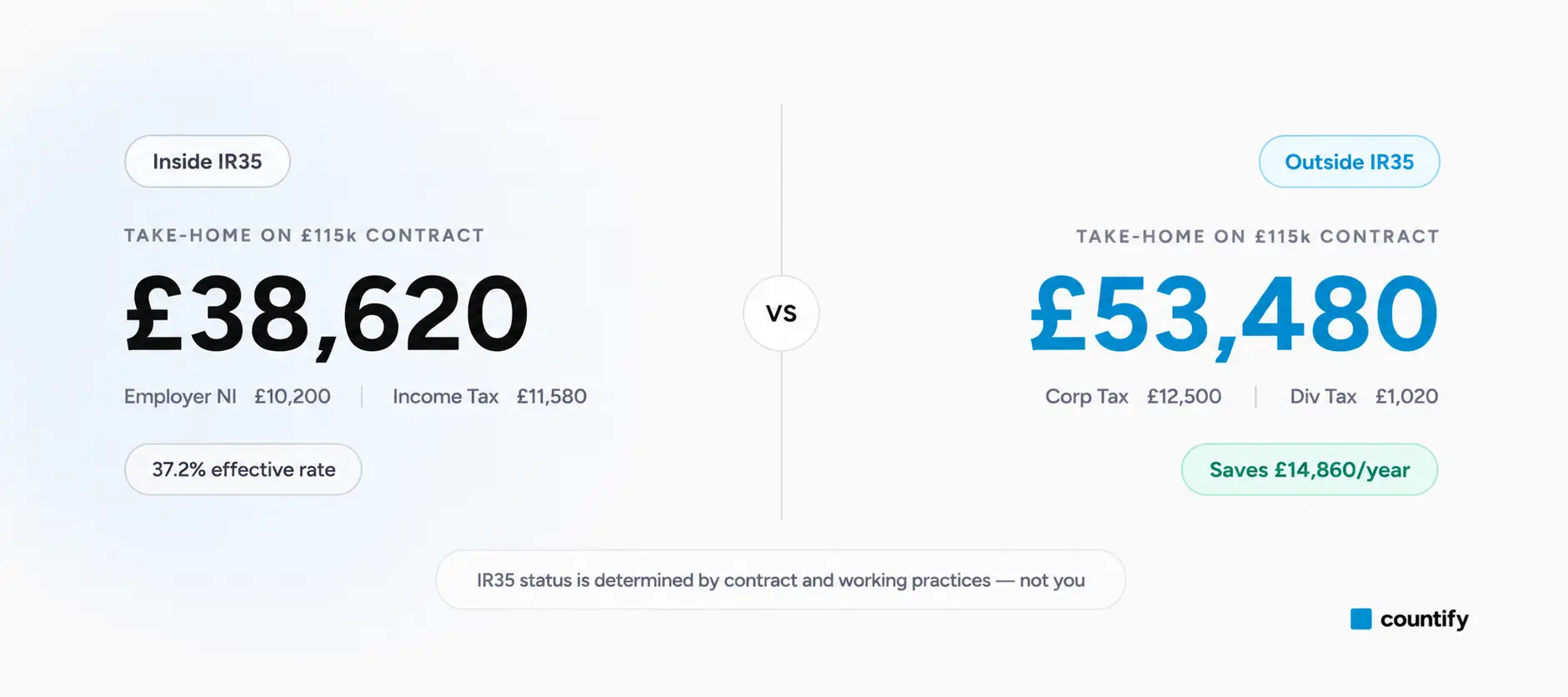
IR35 decides whether a contractor working through their own limited company is taxed like an employee. Outside IR35, you can take a small salary plus dividends, which is usually the most tax-efficient route. Inside IR35, the engagement is treated as deemed employment and taxed through PAYE with employee National Insurance, leaving less take-home. This calculator compares your net pay under both for 2026/27.
Reviewed by Kamran Ishaq FCCA, Founder & CEO · Last updated
Annual contract value
£110,000
Outside IR35 advantage
£3,517/yr
Inside IR35 (deemed PAYE)
£66,415
Effective rate 39.6%
- Employer NI (15%)£13,695.65
- Income Tax£25,953.74
- Employee NI£3,936.09
Outside IR35 (Ltd · salary + dividends)
£69,932
Effective rate 36.4%
- Director's salary£12,570.00
- Corporation Tax£21,768.04
- Dividends after CT£74,526.46
- Dividend tax£17,164.46
Inside IR35 you'd take home £3,517 less on this contract. Talk to us before you sign — status is decided by the working practices, not the label.
Related calculators
Keep planning.
Director Pay Planning
Dividend vs Salary Optimiser
Optimal salary + dividend split for Scottish Ltd Co directors. Scottish 42% higher rate changes the crossover vs rUK.
Structure comparison
Sole Trader vs Ltd Co Calculator
Side-by-side take-home comparison: sole trader vs Ltd Co salary + dividends.
Construction Industry Scheme
CIS Deduction Calculator
20%, 30% or 0% CIS deductions on subcontractor payments. Net payment and annual cost shown.
Take-Home
Salary Take-Home Calculator
Net pay after tax, NI, pension, student loan, bonus and salary sacrifice. Tax codes and Scottish rates supported.
Expert help
Turn your estimate into the right tax decision.
A calculator can model the numbers. Our accountants can check the assumptions, explain the options and handle the return or payroll work for you.
Ask an accountantQuestions
Frequently asked
questions.
Inside IR35 means the engagement is treated as employment for tax purposes. The fee-payer (your agency or end client) deducts employer NI from the contract value first, then runs the remainder through PAYE — so you receive a net amount equivalent to an employee on the same gross salary, without any take-home benefit from operating through a limited company.
It depends on day rate and contract length, but for a £500 day rate across 220 working days, contracting outside IR35 with a low salary plus dividends typically nets around £8,000–£15,000 more per year than the inside-IR35 equivalent. The calculator above shows your exact figure.
For public-sector engagements and medium/large private-sector clients, the end client (or fee-payer) decides status and issues a Status Determination Statement (SDS). For small clients, the contractor's own limited company still decides. HMRC's CEST tool is the most common assessment route, though many advisers (Countify included) treat its output as guidance, not gospel.
Most travel and subsistence expenses are not deductible inside IR35 — the 'deemed employee' is treated as a permanent employee at the client's site for tax purposes. Outside IR35, a limited-company director can claim reasonable business expenses.
Not really. The status applies to the engagement as a whole. Different contracts with different clients can have different statuses, and Countify recommends a working-practices review for each new contract — particularly if you are mid-renewal.
Get started
Take control of your
numbers today.
Free, no-obligation consultation. We agree the fee upfront — no surprises.
5.0 on Google · 8 reviews- Fixed fee agreed in writing before work starts — no surprise bills.
- Switching is handled for you, including the professional clearance letter.
- A named accountant who knows your business, not a call queue.