
Capital Gains
UK Capital Gains Tax (CGT) calculator for property and shares, 2026/27.
Estimate CGT on residential property and other assets at 18% and 24% for 2026/27, including the £3,000 annual exempt amount and Business Asset Disposal Relief at 18%.
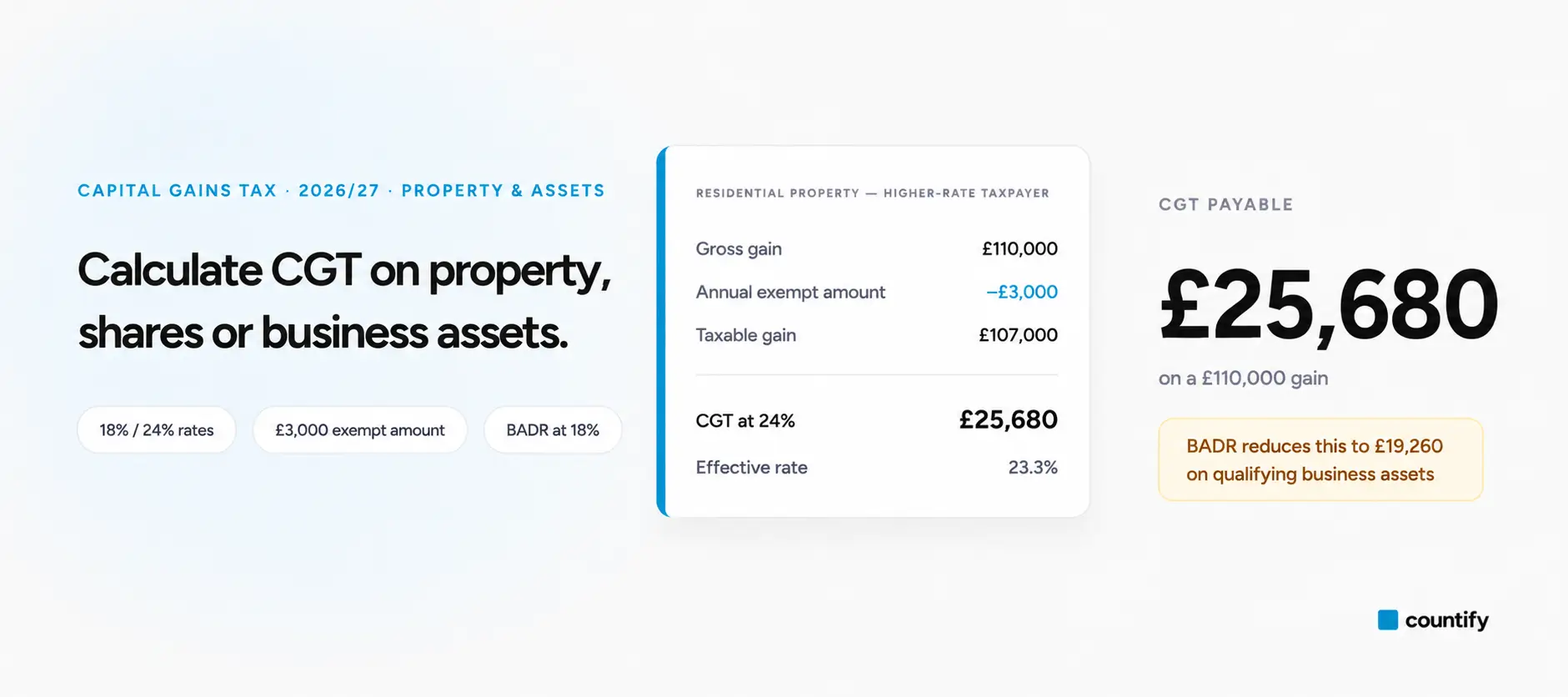
For 2026/27 the Capital Gains Tax annual exempt amount is £3,000. Gains above it are taxed at 18% to the extent they fall within your basic-rate band and 24% above it — for both residential property and other assets. Business Asset Disposal Relief charges a reduced 18% rate on qualifying business disposals, up to a £1 million lifetime limit. CGT applies to the gain, not the full sale price.
Reviewed by Kamran Ishaq FCCA, Founder & CEO · Last updated
CGT due
£22,440
Net after CGT: £74,060 · effective 23.3%
Total gain
£96,500
- Annual exempt
- £3,000.00
- Taxable gain
- £93,500
- Basic / Higher / BADR
- £0 · £22,440 · £0
Related calculators
Keep planning.
Property
Rental Income Tax Calculator
Section 24 mortgage interest credit, allowable expenses, higher-rate landlord impact.
Scottish Property Tax
LBTT Calculator Scotland
Scottish LBTT band by band, with first-time buyer relief, 8% ADS and commercial rates.
Stamp Duty
Stamp Duty & LBTT Calculator
SDLT, Scottish LBTT and Welsh LTT in one place. First-time buyer and ADS supported.
Expert help
Turn your estimate into the right tax decision.
A calculator can model the numbers. Our accountants can check the assumptions, explain the options and handle the return or payroll work for you.
Ask an accountantQuestions
Frequently asked
questions.
Capital Gains Tax in 2026/27 is 18% for gains falling within the basic-rate band and 24% above it, for both residential property and other assets. Business Asset Disposal Relief (BADR) is taxed at 18% on qualifying disposals from 6 April 2026, up to a £1 million lifetime limit.
Selling your main home is normally free of CGT under Private Residence Relief. On a second home or buy-to-let, take a landlord on a £40,000 salary who sells for £250,000 a property bought for £180,000, after £5,000 of improvements and £4,000 of buying and selling costs. The gain is £61,000; after the £3,000 allowance, £58,000 is taxable. The part inside the unused basic-rate band is taxed at 18% and the rest at 24%, a total of £13,304, which must be reported and paid within 60 days of completion.
Yes — each individual has a £3,000 annual exempt amount in 2026/27. Trustees and personal representatives have £1,500. Spouses and civil partners each have their own AEA, so transferring an asset before sale can effectively double the exemption.
Gains on residential property must be reported and paid within 60 days of completion through an HMRC online CGT on UK property account, separate from your Self-Assessment return. Late filing attracts penalties even if no tax is due.
BADR (formerly Entrepreneurs' Relief) reduces CGT to 18% in 2026/27 on the disposal of a trading business, a trading-business interest, or shares in your personal trading company. You must have owned the business or 5%+ of the shares for at least two years.
Yes. Allowable losses are offset against gains in the same tax year, with any excess carried forward indefinitely. The losses must be claimed within four years of the end of the tax year they arose.
Take a basic-rate taxpayer on a £40,000 salary who sells shares for £30,000 that cost £10,000. The gain is £20,000. The first £3,000 is tax free, leaving £17,000 taxable. The part that fits into the unused basic-rate band is taxed at 18% (£1,849) and the rest at 24% (£1,615), so the total bill is £3,464.
Your gain is added on top of your taxable income for the year. Whatever fits into your remaining basic-rate band is taxed at 18%; anything above it is taxed at 24%. That is why a large gain can push a basic-rate taxpayer partly into the higher CGT rate, and why timing a sale across two tax years can use two sets of allowance and basic-rate band.
No. Capital Gains Tax is not devolved, so Scottish taxpayers pay the same CGT rates and use the same UK income tax bands to work out which rate applies — not the Scottish income tax bands. The allowance, reporting rules and reliefs are identical across the UK.
Gains on your main home are usually covered by Private Residence Relief. Shares held in an ISA or pension, private cars, UK government gilts, and most personal possessions worth £6,000 or less are also exempt. Gifts between spouses or civil partners who live together are treated as no gain, no loss, so no tax is due until the receiving partner later sells.
For UK residential property, report and pay within 60 days of completion using HMRC's Capital Gains Tax on UK property service. For shares, crypto and other assets, report the gain on your Self Assessment tax return and pay by 31 January after the end of the tax year — or use HMRC's real-time Capital Gains Tax service to pay sooner if you do not otherwise file a return. You must also report if your total sale proceeds for the year exceed £50,000, even when the gain is covered by the allowance.
Get started
Take control of your
numbers today.
Free, no-obligation consultation. We agree the fee upfront — no surprises.
5.0 on Google · 8 reviews- Fixed fee agreed in writing before work starts — no surprise bills.
- Switching is handled for you, including the professional clearance letter.
- A named accountant who knows your business, not a call queue.