
Dividends
UK dividend tax calculator for salary and dividends (2026/27).
Work out the personal tax on dividends for 2026/27 across the £500 dividend allowance and the 10.75%, 35.75% and 39.35% bands. Optimised for limited-company directors taking salary plus dividends.
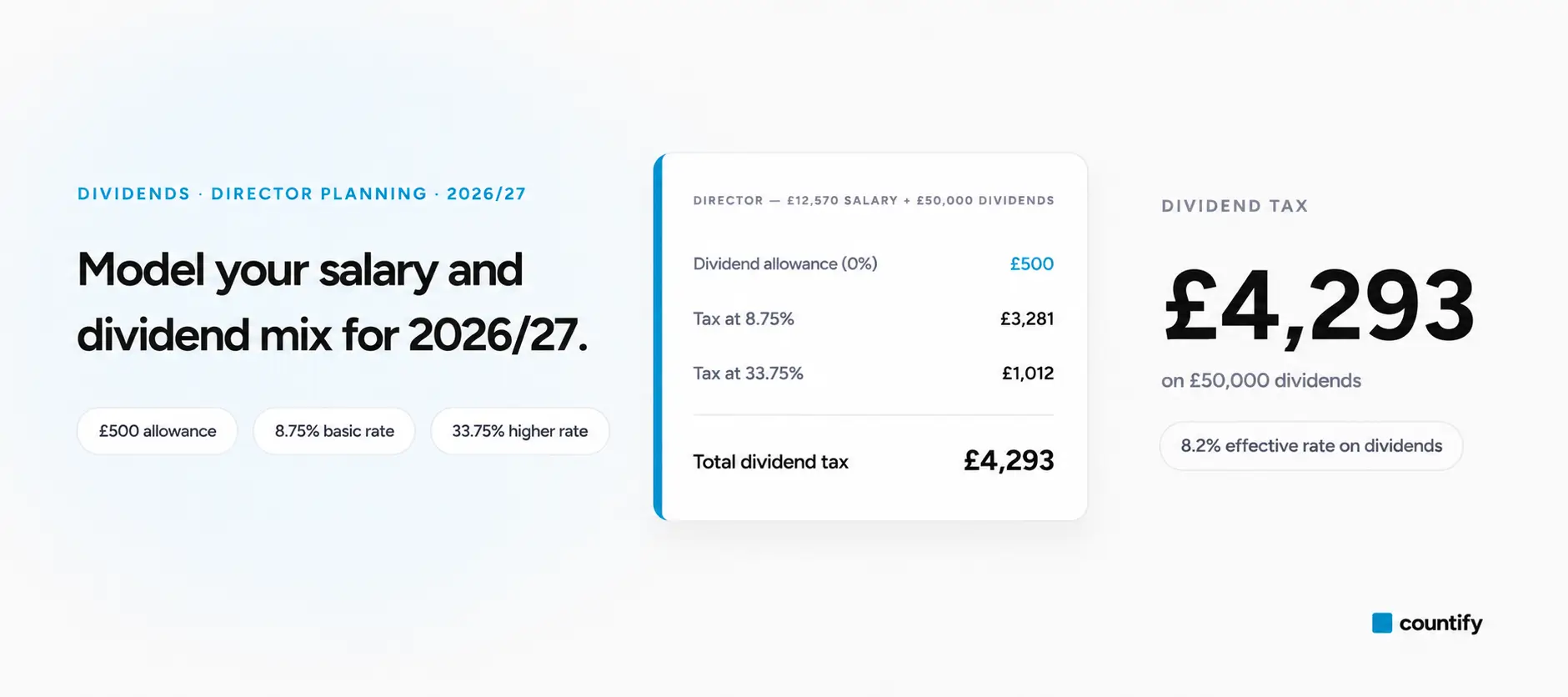
For 2026/27 the first £500 of dividends is tax-free under the dividend allowance. Dividends above that are taxed at 10.75% in the basic-rate band, 35.75% in the higher-rate band and 39.35% in the additional-rate band. Dividends are treated as the top slice of your income, so your salary and other earnings decide which rate each pound of dividend is taxed at.
Reviewed by Kamran Ishaq FCCA, Founder & CEO · Last updated
Take-home (post-tax)
£47,749
Total tax £4,821.25 · effective 9.2%
Dividend tax
£4,821.25
Dividend bands
- Dividend allowance (0%)£500.00
- Basic rate (10.75%)£37,200.00 → £3,999.00
- Higher rate (35.75%)£2,300.00 → £822.25
- Additional rate (39.35%)£0.00 → £0.00
- Income tax on salary£0.00
Worked examples
Dividend tax on a
director's draw.
The personal dividend tax due for 2026/27 on a director taking the typical £12,570 salary plus dividends on top. The first £500 of dividends is covered by the dividend allowance; the rest is taxed at 10.75% in the basic-rate band, then 35.75%.
| Dividends drawn | Dividend tax | Net in pocket |
|---|---|---|
| £10,000 | £1,021 | £8,979 |
| £20,000 | £2,096 | £17,904 |
| £30,000 | £3,171 | £26,829 |
| £40,000 | £4,821 | £35,179 |
| £50,000 | £8,396 | £41,604 |
Personal dividend tax only, on a £12,570 salary, for 2026/27. Figures exclude Corporation Tax already paid by the company and assume no other income — use the calculator above to model your own salary and dividend mix.
Related calculators
Keep planning.
Director Pay Planning
Dividend vs Salary Optimiser
Optimal salary + dividend split for Scottish Ltd Co directors. Scottish 42% higher rate changes the crossover vs rUK.
Corporation Tax
Corporation Tax Estimator
Estimate CT600 with marginal relief between £50k and £250k profit.
Structure comparison
Sole Trader vs Ltd Co Calculator
Side-by-side take-home comparison: sole trader vs Ltd Co salary + dividends.
Expert help
Turn your estimate into the right tax decision.
A calculator can model the numbers. Our accountants can check the assumptions, explain the options and handle the return or payroll work for you.
Ask an accountantQuestions
Frequently asked
questions.
Dividends above the £500 dividend allowance are taxed at 10.75% within the basic-rate band, 35.75% in the higher-rate band and 39.35% in the additional-rate band. The basic and higher rates each rose by 2 percentage points on 6 April 2026; the additional rate is unchanged.
The £12,570 personal allowance is used first against your total income, including dividends. Once it is exhausted, the £500 dividend allowance taxes the next slice of dividends at 0% — but those dividends still count toward your income-tax bands.
For 2026/27, a common structure is to take a salary up to the Class 1 Primary Threshold (£12,570) and the remainder as dividends. The salary preserves National Insurance credits, the dividends avoid employee and employer NI, and Corporation Tax relief is given on the salary cost. Countify can model this against your specific Corporation Tax position.
No. Dividend tax uses the UK-wide rates and bands; Scottish income-tax rates only apply to non-savings, non-dividend income such as salary and self-employed profit.
Dividend tax above the dividend allowance is settled through Self-Assessment. The balancing payment is due by 31 January following the tax year. If liabilities exceed £1,000, payments on account also apply.
Get started
Take control of your
numbers today.
Free, no-obligation consultation. We agree the fee upfront — no surprises.
5.0 on Google · 8 reviews- Fixed fee agreed in writing before work starts — no surprise bills.
- Switching is handled for you, including the professional clearance letter.
- A named accountant who knows your business, not a call queue.