
New company
First-year checklist for new UK limited companies.
Answer 8 questions about your newly incorporated company and get a personalised, date-stamped checklist of every HMRC deadline, filing obligation and set-up task you must complete in year one — exported as a printable PDF.
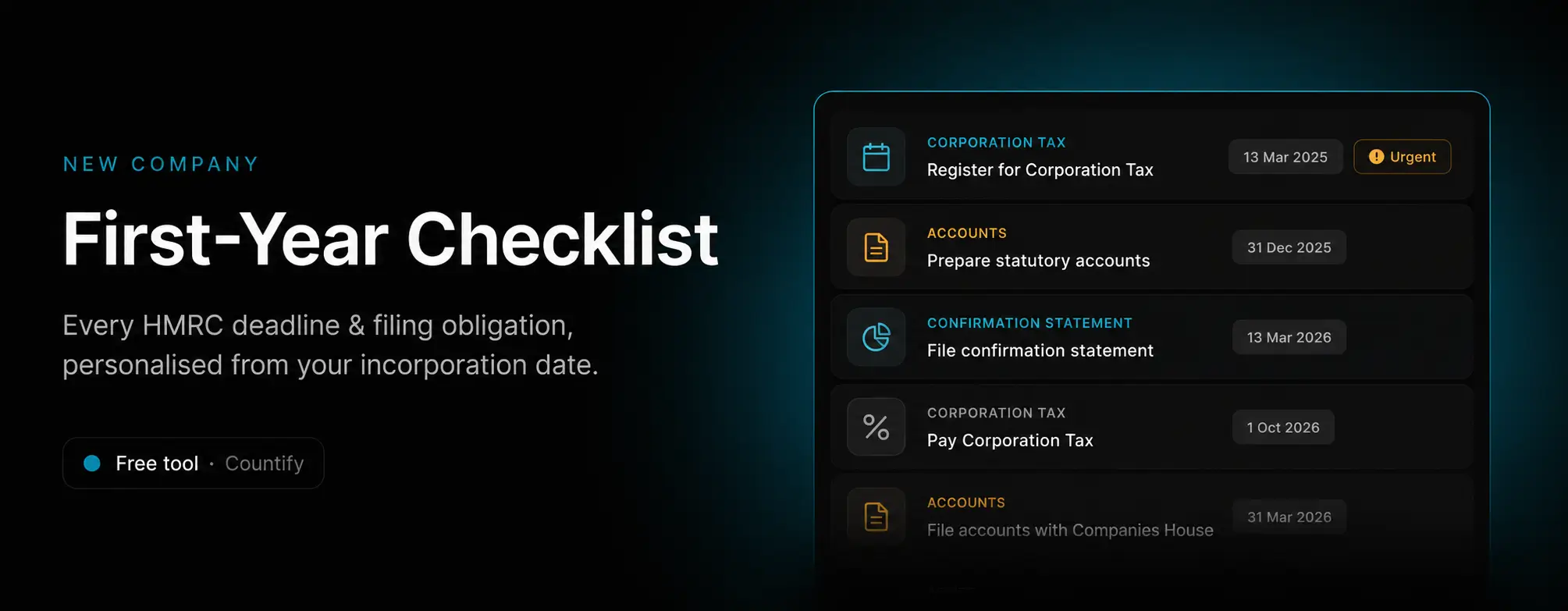
A new UK limited company must register for Corporation Tax with HMRC within 3 months of starting to trade, file a Confirmation Statement at Companies House every year, and file its first annual accounts within 21 months of incorporation. You may also need to register for PAYE, VAT (once turnover exceeds £90,000) and Self-Assessment. This tool generates a personalised, date-stamped checklist of every deadline from your incorporation date.
Reviewed by Kamran Ishaq FCCA, Founder & CEO · Last updated
Companies House
File your first Confirmation Statement
By 24 October 2027 (within 12 months + 14 days)
File your first annual accounts with Companies House
By 10 July 2028 (21 months from incorporation)
HMRC registration
Register for Corporation Tax with HMRC
Within 3 months of starting to trade (by 10 January 2027)
Corporation Tax
Pay your Corporation Tax
By 10 July 2028 (9 months + 1 day after period end)
File your first Company Tax Return (CT600)
By 9 October 2028
Self-Assessment
Register for Self-Assessment
By 5 October 2027
File your first Self-Assessment return
By 31 January 2028 (online)
Banking & insurance
Open a business bank account
As soon as possible
Consider professional indemnity insurance
OptionalBefore taking on client work
Bookkeeping
Set up a bookkeeping system
As soon as possible
General guidance based on HMRC and Companies House rules for 2026/27. Countify can handle every item for you — talk to us to take it off your plate.
Related calculators
Keep planning.
Deadlines
Tax Deadline Checker
Self-Assessment, VAT, CT600, P11D and Confirmation Statement — late-filing exposure.
VAT
VAT Threshold Checker
Rolling 12-month turnover vs £90k threshold. Cash-flow impact of registration modelled.
Clearance letter
Clearance Letter Generator
Tell us once. We auto-draft your professional clearance letter and start the handover today.
Expert help
Turn your estimate into the right tax decision.
A calculator can model the numbers. Our accountants can check the assumptions, explain the options and handle the return or payroll work for you.
Ask an accountantQuestions
Frequently asked
questions.
Your first Company Tax Return (CT600) is due 12 months after the end of your first accounting period, which normally ends on the anniversary of the month you incorporated. Note the trap: the tax itself is due earlier — 9 months and 1 day after the period end — so most companies pay before they file. You must also tell HMRC the company is active within 3 months of starting to trade.
Not unless you expect taxable turnover to reach the £90,000 registration threshold. Below that, registration is optional — registering voluntarily lets you reclaim input VAT but means charging VAT to your customers. Keep an eye on your rolling 12-month turnover: once it passes £90,000 you must register within 30 days, so it pays to watch the figure as you approach it.
The Confirmation Statement (form CS01) is an annual Companies House filing confirming your registered details. Your first review period normally ends 12 months after incorporation and you then have 14 days to file. The online fee is £50. It is separate from your accounts and is required even if nothing has changed.
Only if the company pays you a salary. If you draw a director's salary through the company you must register as an employer and run PAYE, submitting Real Time Information to HMRC on or before each payday — even with one director. Many owner-managed companies take a small salary plus dividends, which still requires a PAYE scheme. If you take dividends only and no salary, you may not need PAYE, but it's worth checking the most tax-efficient mix with us first.
Making Tax Digital (MTD) means keeping digital records and filing through compatible software. MTD for VAT already applies to all VAT-registered businesses. MTD for Income Tax Self-Assessment is being phased in from April 2026 for individuals with qualifying income over £50,000, which can affect you personally as a director. For the company itself, the key digital requirement today is MTD for VAT once you register — so choosing cloud accounting software from day one keeps you compliant and saves work later.
Get started
Take control of your
numbers today.
Free, no-obligation consultation. We agree the fee upfront — no surprises.
5.0 on Google · 8 reviews- Fixed fee agreed in writing before work starts — no surprise bills.
- Switching is handled for you, including the professional clearance letter.
- A named accountant who knows your business, not a call queue.