
Corporation Tax
UK Corporation Tax Calculator (2026/27).
Estimate UK Corporation Tax for the 2026/27 financial year, including marginal relief between the £50,000 small-profits threshold and the £250,000 main-rate threshold, with associated-company adjustments.
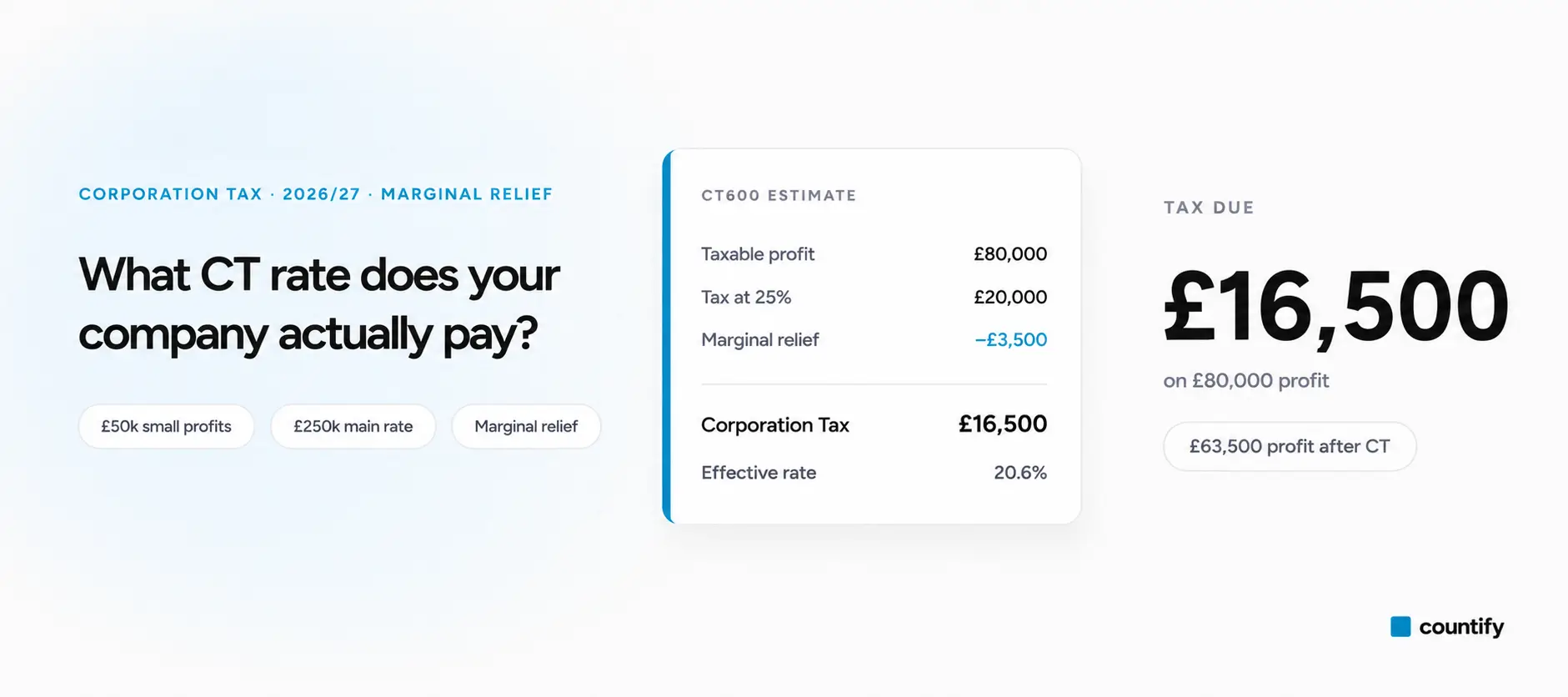
For the 2026/27 financial year, UK Corporation Tax is 19% on profits up to £50,000 (the small-profits rate) and 25% on profits of £250,000 or more (the main rate). Profits between £50,000 and £250,000 are charged at 25% with marginal relief, giving an effective rate of 26.5% on profits in that band. Both thresholds are shared between associated companies.
Reviewed by Kamran Ishaq FCCA, Founder & CEO · Last updated
Corporation Tax due
£17,450
Marginal relief (25% less MR)
Effective rate
21.8%
- Profit after CT
- £62,550
- Lower threshold
- £50,000
- Upper threshold
- £250,000
Marginal relief breakdown
- Tax at 25% main rate£20,000.00
- Less marginal relief (3/200)−£2,550.00
- CT payable£17,450.00
Worked examples
Corporation Tax
across the bands.
The Corporation Tax due on common profit levels for the 2026/27 financial year, assuming one company with no associated companies. Notice the effective rate climb from 19% to 25% through the £50,000–£250,000 marginal-relief band.
| Taxable profit | Corporation Tax | Effective rate |
|---|---|---|
| £30,000 | £5,700 | 19% |
| £50,000 | £9,500 | 19% |
| £100,000 | £22,750 | 22.8% |
| £150,000 | £36,000 | 24% |
| £250,000 | £62,500 | 25% |
| £500,000 | £125,000 | 25% |
Estimates for the 2026/27 financial year. Associated companies, ring-fence profits and accounting periods that straddle 1 April are handled differently — use the calculator above, or speak to Countify.
Related calculators
Keep planning.
Director Pay Planning
Dividend vs Salary Optimiser
Optimal salary + dividend split for Scottish Ltd Co directors. Scottish 42% higher rate changes the crossover vs rUK.
R&D Tax Credit
R&D Tax Relief Estimator
Merged R&D scheme: 20% above-the-line credit on qualifying expenditure. Loss-making rate shown.
Capital Allowances
AIA Checker
£1m AIA on plant and machinery. 18% Writing Down Allowance on the remainder.
Expert help
Turn your estimate into the right tax decision.
A calculator can model the numbers. Our accountants can check the assumptions, explain the options and handle the return or payroll work for you.
Ask an accountantQuestions
Frequently asked
questions.
Companies with taxable profits up to £50,000 pay the small-profits rate of 19%. Above £250,000 the main rate of 25% applies. Between these thresholds the company is in the marginal-relief band — it pays 25% but receives a sliding-scale rebate using HMRC's 3/200 marginal-relief fraction.
Marginal relief is calculated as 3/200 × (£250,000 − augmented profits). This produces an effective tax rate between 19% and 26.5% as profits rise through the band. The calculator above shows the gross 25% charge and the marginal relief deduction separately.
Two companies are associated if one controls the other, or both are controlled by the same person or group of people. Associated companies share the £50,000 and £250,000 thresholds equally, which can push your company into the higher band sooner. The rules tightened from 1 April 2023 — Countify can review your group structure to confirm exposure.
Yes — Corporation Tax rates apply by financial year (FY) running 1 April to 31 March. An accounting period that straddles two financial years is apportioned. For an April-to-March year-end, FY 2026 covers the whole period and the rates above apply throughout.
The CT600 return is due 12 months after the end of the accounting period. The Corporation Tax payment is due earlier — 9 months and 1 day after the period end (or in quarterly instalments for very large companies). Use our deadline checker to confirm your exposure.
You pay Corporation Tax to HMRC online — by bank transfer, Faster Payments, Direct Debit or corporate debit card — quoting the company's Corporation Tax payment reference, which is built from its Unique Taxpayer Reference. HMRC does not send a bill. Paying late triggers late payment interest from the day after the deadline, even if the CT600 return itself is not yet due.
Yes. A company does not pay Capital Gains Tax; instead, chargeable gains on selling property, shares or other capital assets are added to its taxable profits and taxed at the Corporation Tax rate that applies. Companies get no annual exempt amount, and indexation allowance is frozen at December 2017. Disposals of a 10%+ holding in another trading company may be exempt under the Substantial Shareholding Exemption.
Get started
Take control of your
numbers today.
Free, no-obligation consultation. We agree the fee upfront — no surprises.
5.0 on Google · 8 reviews- Fixed fee agreed in writing before work starts — no surprise bills.
- Switching is handled for you, including the professional clearance letter.
- A named accountant who knows your business, not a call queue.